

Career Mistakes to Avoid in Pakistan (2026 Complete Guide)
Quick Answer: The most common career mistakes to avoid in Pakistan include choosing a field based on family pressure alone, applying to jobs without tailoring resumes, ignoring networking, neglecting skill development, and staying too long in a stagnant role. Avoiding these mistakes requires proactive planning, honest self-assessment and continuous learning.
Some career setbacks are unavoidable, but many are self-inflicted, repeated by thousands of job seekers every year. This guide walks through the most common career mistakes to avoid at each stage and how to correct them.
Table of Contents
- Mistakes When Choosing a Career
- Mistakes During the Job Search
- Mistakes in Resume and Application
- Mistakes in Interviews
- Mistakes in the First Year of a Job
- Mistakes in Mid-Career Growth
- Mistakes in Skill Development
- Mistakes in Networking
- Recovery Roadmap
- Comparing Mistakes by Career Stage
- Frequently Asked Questions
Mistakes When Choosing a Career
Best for (who this applies to): Students and fresh graduates deciding on a field of study or first career direction.
Common mistakes:
- Choosing a field only due to family pressure or social status
- Following friends into a field without personal interest
- Ignoring market demand in favor of passion alone
- Dismissing technical/vocational paths due to stigma
Required Fix:
- Conduct honest self-assessment before committing to a field
- Research actual job market demand, not just prestige
- Talk to professionals already working in the field
Mistakes During the Job Search
Best for: Fresh graduates and job seekers actively applying for roles.
Common mistakes:
- Applying to hundreds of jobs without any targeting or strategy
- Waiting passively for the “perfect” job instead of gaining early experience
- Ignoring referrals and networking in favor of only online applications
- Not researching companies before applying
Career Roadmap to Fix: Identify Target Roles/Industries → Tailor Applications Specifically → Leverage Network for Referrals → Track and Follow Up on Applications
Mistakes in Resume and Application
Best for: Anyone actively applying for jobs in Pakistan.
Common mistakes:
- Sending the same generic resume to every job
- Listing skills without specific examples or evidence
- Including outdated or irrelevant information
- Poor formatting or excessive length
Required Fix:
- Tailor your resume for each specific role and industry
- Use the situation–action–result approach for achievements
- Keep it concise — one page for fresh graduates
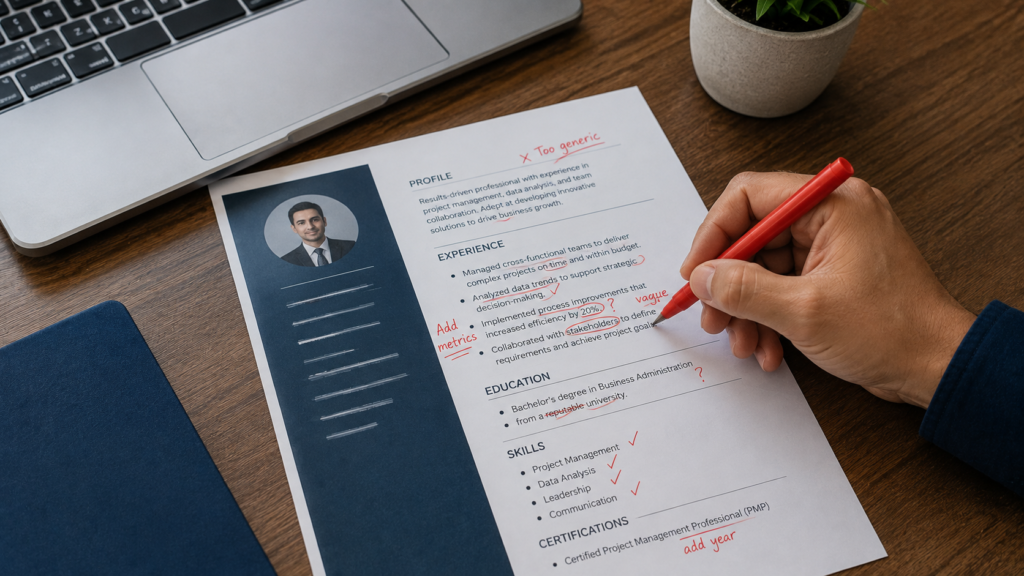
A generic, untailored resume is one of the most common career mistakes to avoid.
Mistakes in Interviews
Best for: Job seekers preparing for interviews at any career stage.
Common mistakes:
- Failing to research the company beforehand
- Giving vague answers without specific examples
- Speaking negatively about previous employers or experiences
- Not preparing thoughtful questions to ask the interviewer
Career Roadmap to Fix: Research Company & Role → Prepare 2–3 Strong Examples → Practice Mock Interviews → Prepare Questions to Ask → Confident Interview Performance
Mistakes in the First Year of a Job
Best for: Fresh employees navigating their first professional role.
Common mistakes:
- Being reluctant to ask questions or seek clarification
- Avoiding feedback instead of actively requesting it
- Failing to build relationships beyond your immediate team
- Stopping skill development once hired
Required Fix:
- Ask questions proactively rather than guessing
- Seek regular feedback from supervisors
- Build relationships across departments, not just your own team
Mistakes in Mid-Career Growth
Best for: Professionals with a few years of experience aiming for promotion or specialization.
Common mistakes:
- Staying in a stagnant role too long without seeking growth
- Avoiding difficult conversations about promotions or raises
- Failing to update skills as industry tools evolve
- Not building a visible professional reputation (LinkedIn, industry presence)
Career Roadmap to Fix: Assess Current Growth Trajectory → Have Direct Conversations with Management → Pursue Relevant Certifications/Specialization → Build External Professional Visibility
Typical Employers Where This Applies: Unilever Pakistan, HBL, Systems Limited, and similar structured organizations with defined promotion cycles.
For general standards on professional certification and development, you can also reference the Higher Education Commission of Pakistan.

Pursuing growth conversations and certifications helps break mid-career stagnation.
Mistakes in Skill Development
Best for: Professionals at any stage who want to remain competitive.
Common mistakes:
- Assuming a degree alone is enough without practical skills
- Learning skills only in theory without real project application
- Ignoring digital and technical skills outside one’s core field
- Not tracking which skills are gaining or losing market demand
Required Fix:
- Continuously apply new skills through real projects
- Research industry trends regularly to prioritize relevant skills
- Balance technical (hard) skills with communication (soft) skills
Mistakes in Networking
Best for: Job seekers and professionals at every career stage.
Common mistakes:
- Only reaching out to contacts when actively job searching
- Avoiding LinkedIn or professional platforms altogether
- Failing to maintain relationships with former colleagues or classmates
- Being purely transactional instead of building genuine relationships
Required Fix:
- Maintain professional relationships consistently, not just when needed
- Engage authentically on platforms like LinkedIn
- Offer help to your network, not just ask for it
Pro Tip: Reconnect with former classmates and colleagues periodically — even a simple congratulatory message on a new job can keep a professional relationship active for future opportunities.
Recovery Roadmap — Fixing Career Mistakes
Identify the Specific Mistake → Acknowledge Impact Honestly → Take a Concrete Corrective Action → Monitor Progress → Build a Habit to Prevent Recurrence
Comparing Mistakes by Career Stage
| Career Stage | Most Common Mistake | Quick Fix |
|---|---|---|
| Choosing a Career | Following family/peer pressure blindly | Self-assessment + market research |
| Job Search | Applying without targeting | Strategic, tailored applications |
| Resume/Application | Generic resume for every job | Tailor for each specific role |
| Interviews | Vague, unprepared answers | Prepare specific examples |
| First Year of Job | Avoiding feedback | Actively seek supervisor feedback |
| Mid-Career | Staying stagnant too long | Pursue growth conversations/specialization |
| Skill Development | Learning only in theory | Apply skills through real projects |
| Networking | Only reaching out when job searching | Maintain relationships consistently |
Frequently Asked Questions
Q1. What is the most common career mistake in Pakistan?
Choosing a field of study or first job based purely on family pressure or social status, without personal interest or market research.
Q2. How can I avoid mistakes in my job search?
Apply strategically to targeted roles, tailor your resume for each application, and actively leverage your professional network.
Q3. Is it a mistake to stay in the same job for many years?
Not inherently, but staying in a role without growth or learning opportunities for too long can limit long-term career progress.
Q4. What mistakes do fresh graduates commonly make in interviews?
Failing to research the company beforehand, giving vague answers, and not preparing thoughtful questions to ask.
Q5. How important is networking in avoiding career mistakes?
Very important. Many career opportunities in Pakistan come through referrals, and neglecting networking is a common mistake.
Q6. What is a common mistake professionals make in mid-career growth?
Avoiding direct conversations about promotions or raises, and failing to update skills as industry tools evolve.
Q7. Should I avoid taking a job outside my field of study?
Not necessarily — being overly rigid about staying only within your exact field can limit valuable early career opportunities.
Q8. How can I recover from a career mistake I’ve already made?
Acknowledge the mistake honestly, take a concrete corrective action, and build habits to prevent it from recurring.
Q9. What is a common resume mistake in Pakistan’s job market?
Sending the same generic, untailored resume to multiple job applications.
Q10. Is it a mistake to avoid feedback at work?
Yes. Avoiding feedback, especially in your first year, can slow down learning and growth significantly.
Q11. How can I avoid stagnation in my career?
Regularly assess your growth trajectory, seek new skills and responsibilities, and have direct conversations with management.
Q12. What role does continuous learning play in avoiding career mistakes?
A significant one — professionals who stop developing skills often fall behind as industries and employer expectations evolve.
Summary
Many career setbacks in Pakistan stem from avoidable mistakes — poor career choices made under pressure, generic job applications, neglected networking, and stalled skill development. Knowing these career mistakes to avoid allows for proactive correction at every career stage.
Key Takeaways
- Career choices should be based on self-assessment and market research, not pressure alone.
- Tailored, strategic job applications outperform mass, generic applications.
- Networking should be maintained consistently, not just during active job searches.
- Continuous skill development is essential to avoid long-term stagnation.
- Most career mistakes can be corrected with honest reflection and concrete action.
Suggested Reading
Continue with our career planning guide, fresh graduate career guide, or our career change guide.
Official Resources
- Higher Education Commission of Pakistan (HEC — Official Website)
- National Vocational and Technical Training Commission (NAVTTC — Official Website)
Readers should verify current job market conditions and hiring practices directly from official and industry sources.