

Pak Army Eligibility Criteria: Complete Breakdown
Quick Answer: Pak Army eligibility criteria cover six main areas: age (which varies by entry scheme), educational qualification, physical standards (height, weight, chest measurement), medical and vision requirements, nationality and domicile, and marital status restrictions specific to certain schemes. The exact numbers differ significantly between Long Course, Short Service Commission, Direct Entry, and other paths, so checking the criteria for your specific intended entry scheme matters more than reading a single general age or qualification figure.
Before spending months preparing for a written test or building physical fitness for the ISSB assessment, it’s worth confirming you actually meet the baseline eligibility for the entry scheme you’re targeting. Pak Army eligibility criteria aren’t one uniform set of numbers — they shift meaningfully depending on whether you’re applying through Long Course, Short Service Commission, Direct Entry as a specialist, or one of the other paths covered in the Pak Army Complete Guide. This article breaks down each eligibility area in detail so you can confirm fit before committing to preparation.
Table of Contents
- Age Requirements by Entry Scheme
- Educational Qualification Requirements
- Physical Standards: Height, Weight, and Chest Measurement
- Medical and Vision Requirements
- Nationality, Domicile, and Marital Status
- How to Confirm Pak Army Eligibility Criteria Before You Apply
- Common Mistakes When Checking Eligibility
- Frequently Asked Questions
Age Requirements by Entry Scheme
Direct Answer: Age eligibility for Pak Army entry schemes generally falls within a defined window specific to each scheme, with Long Course typically targeting a narrower, younger age range than Short Service Commission or Direct Entry.
Long Course candidates are usually expected to apply within a relatively young age bracket following completion of intermediate or a bachelor’s degree, since it leads to a long-term career commitment. Short Service Commission tends to allow a slightly wider age window, reflecting its shorter service term. Direct Entry for specialists like doctors and engineers often has its own separate age bracket tied to the additional years typically needed to complete a professional degree before applying.
Practical Guidance: Because exact age brackets are reviewed periodically by the Army and can shift between recruitment cycles, always confirm the current age window for your specific scheme against the official recruitment notification rather than relying on a general figure from memory or an outdated source.
Educational Qualification Requirements
Direct Answer: Minimum educational qualification depends entirely on the entry scheme, ranging from intermediate-level for some officer-track paths up to a relevant professional degree for Direct Entry specialists.
Long Course generally accepts candidates who’ve completed intermediate (FA/FSc) or equivalent, with some schemes preferring a bachelor’s degree. Short Service Commission commonly requires a completed bachelor’s degree. Direct Entry is different in kind rather than degree — it requires the specific professional qualification relevant to the specialist role, such as an MBBS for medical entry or a relevant engineering degree for technical corps entry, since these candidates join at officer rank based on existing expertise rather than general academic standing.
Physical Standards: Height, Weight, and Chest Measurement
Direct Answer: Physical standards set minimum height, a proportional weight range, and a minimum chest measurement (often with an expansion requirement), and these apply across nearly all entry schemes regardless of academic qualification.
These measurements exist because military service has genuine physical demands that differ from most civilian roles, and they’re checked early in the selection process specifically so candidates who don’t meet baseline physical standards aren’t carried through the more time-intensive written test and ISSB stages. Requirements can differ slightly by scheme and, in some cases, by specific corps within a scheme.
Practical Guidance: If you’re unsure whether you currently meet the height or weight standard for your target scheme, it’s worth checking early rather than assuming, since these are the criteria least likely to be waived or relaxed compared to age or qualification exceptions that sometimes apply to specific applicant categories.
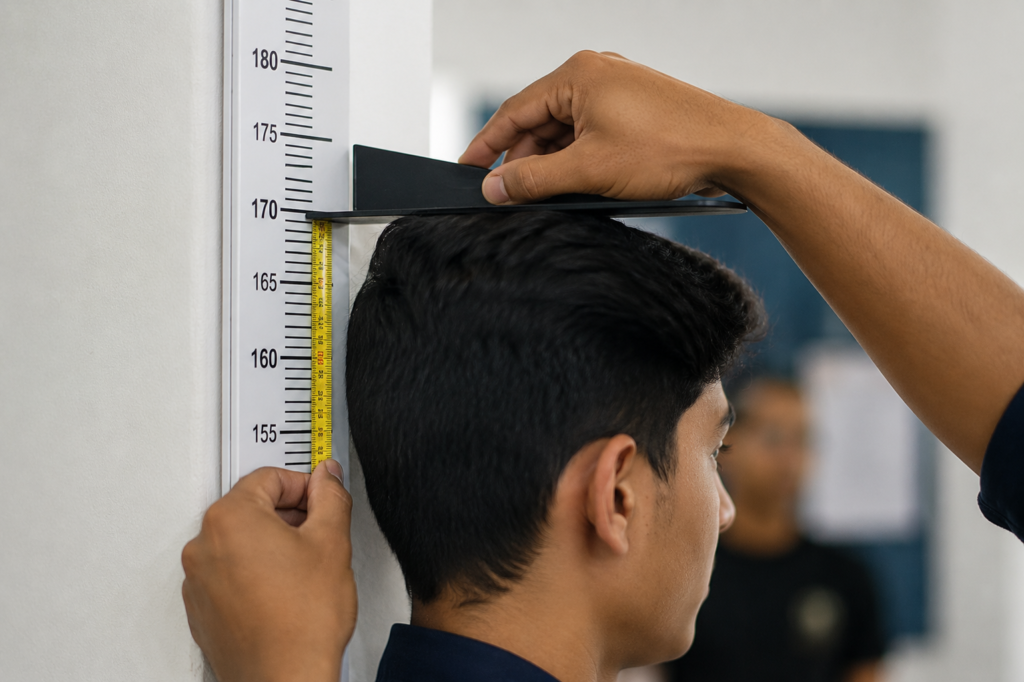
Height, weight, and chest measurement are checked early in the selection process.
Medical and Vision Requirements
Direct Answer: Medical eligibility covers general physical health, vision standards (often including limits on corrective lens dependency for certain roles), and the absence of specific disqualifying medical conditions.
Vision requirements can vary meaningfully by corps — flying-related roles and certain technical positions tend to have stricter vision standards than general infantry or administrative roles. A formal medical examination is typically conducted at a specific stage of the selection process, after the written test and initial screening, rather than at the point of application.
Nationality, Domicile, and Marital Status
Direct Answer: Pakistani nationality is a baseline requirement across all entry schemes, and certain schemes also apply domicile-related considerations or marital status restrictions specific to that scheme’s terms.
Marital status restrictions, where they apply, are generally scheme-specific rather than universal — some entry paths require candidates to be unmarried at the point of commissioning, while this doesn’t apply uniformly across every scheme. Domicile considerations can factor into certain regional recruitment quotas, though this varies by scheme and shouldn’t be assumed without checking the specific notification for your target path.

Matching your documents to the correct entry scheme’s requirements avoids delays later.
How to Confirm Pak Army Eligibility Criteria Before You Apply
Rather than relying on general knowledge of “Pak Army requirements,” pull up the specific, current notification for your target entry scheme and check each of the five areas above against it individually: age, qualification, physical standards, medical/vision, and nationality/domicile/marital status. If you’re borderline on any single criterion — a few months outside an age window, for example — it’s worth checking directly whether any relaxation applies to your situation rather than assuming you’re automatically ineligible.
Common Mistakes When Checking Eligibility
Assuming eligibility criteria are identical across all entry schemes is the most common mistake, when in reality Long Course, Short Service Commission, and Direct Entry each have meaningfully different requirements. Relying on outdated information from a previous recruitment cycle, rather than the current notification, is another frequent issue given that criteria are periodically revised. Finally, assuming a borderline physical measurement will be waived without confirming this directly often leads to disappointment at the medical screening stage rather than before investing months in preparation.
Frequently Asked Questions
What is the age limit for Pak Army eligibility criteria under Long Course?
Long Course typically targets a relatively young age bracket following intermediate or bachelor’s-level education, though the exact current window should always be confirmed against the official recruitment notification, since it’s periodically reviewed.
Do Pak Army eligibility criteria differ for Direct Entry specialists?
Yes, significantly. Direct Entry for doctors, engineers, and other specialists is based on the candidate’s existing professional qualification and often has its own separate age bracket that accounts for the additional years needed to complete that degree.
What happens if I don’t meet the height or chest measurement requirement?
Physical standards are generally the least flexible of the eligibility criteria and are checked early in the process. If you’re close to but below a specific measurement, it’s worth confirming directly with the recruitment office rather than assuming disqualification or eligibility.
Can married candidates apply under Pak Army eligibility criteria?
It depends on the specific entry scheme — some schemes require candidates to be unmarried at commissioning, while this restriction doesn’t apply uniformly across every path, so checking your specific scheme’s current terms directly is important.
Summary
Pak Army eligibility criteria span six areas — age, qualification, physical standards, medical and vision requirements, and nationality/domicile/marital status — and each varies meaningfully by entry scheme rather than following one universal set of numbers. Confirming your fit against the current, scheme-specific notification before beginning preparation avoids months of misdirected effort toward a path you may not currently qualify for.
Key Takeaways
- Eligibility criteria differ significantly between Long Course, Short Service Commission, and Direct Entry — there is no single universal standard.
- Physical standards (height, weight, chest measurement) are checked early and are generally the least flexible criteria.
- Medical and vision requirements can vary by corps, particularly for flying-related and technical roles.
- Always confirm current criteria against the official notification, since numbers are periodically revised.
- Borderline cases on age or physical measurements are worth checking directly rather than assuming.
Suggested Reading
Pak Army Complete Guide · Pak Army Written Test Syllabus · ISSB Interview Preparation Guide · Pak Army Salary and Rank Structure
Official Resources
For current, authoritative eligibility notifications by scheme, always check the official Pak Army recruitment portal.