

How to Write a Cover Letter for Jobs in Pakistan (2026 Guide)
Quick Answer: Learning how to write a cover letter for jobs in Pakistan means keeping it concise (under one page), addressing the specific role and company, highlighting 2–3 relevant achievements, and explaining why you’re a strong fit. It should complement your resume, not repeat it word for word.
A cover letter gives you space to explain your motivation and fit in a way a resume alone cannot. This guide covers how to write a cover letter for jobs in Pakistan effectively, including structure, examples and common mistakes to avoid.
Table of Contents
- Do You Always Need a Cover Letter
- Cover Letter Structure
- Writing the Opening Paragraph
- Writing the Body Paragraphs
- Writing the Closing Paragraph
- Example Cover Letter
- Cover Letter Writing Roadmap
- Tips and Common Mistakes
- Frequently Asked Questions
Do You Always Need a Cover Letter
Best for: Job seekers applying to roles that explicitly request a cover letter, or where the application allows for one and you want to stand out.
Consider: Not every job application in Pakistan requires a cover letter, but including a strong one when optional can meaningfully differentiate you from other candidates who skip it.
Cover Letter Structure
- Header (your contact info, date, employer’s details)
- Greeting (addressed to a specific person where possible)
- Opening paragraph (state the role and your interest)
- Body paragraph(s) (relevant achievements and fit)
- Closing paragraph (call to action, thank you)
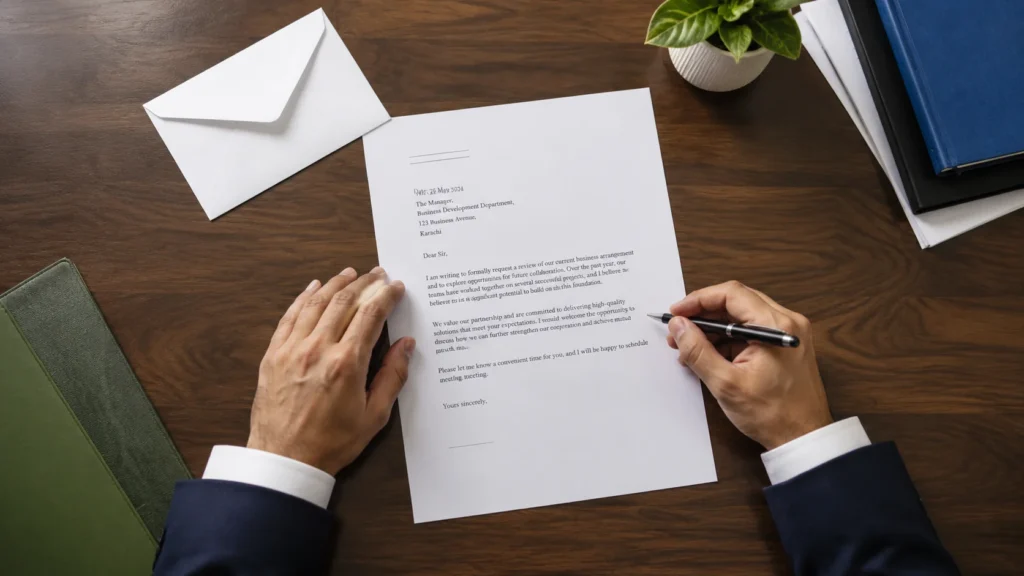
A clear structure — header, greeting, body and closing — makes a cover letter easy to read.
Writing the Opening Paragraph
Required Skills:
- Clearly stating the specific role you’re applying for
- Briefly conveying genuine interest and enthusiasm
Example: “I am writing to apply for the Marketing Executive position at Unilever Pakistan, as advertised on your careers page. With hands-on experience in digital campaign management from two internships, I am excited about the opportunity to contribute to your brand team.”
Writing the Body Paragraphs
Required Skills:
- Selecting 2–3 specific, relevant achievements
- Connecting your background directly to the job requirements
- Avoiding simply repeating your resume word for word
Career Roadmap: Review Job Requirements → Select 2–3 Matching Achievements → Explain Specific Impact/Outcome → Connect Directly to How You’ll Add Value in This Role
Pro Tip: Pick achievements that aren’t already the headline of your resume — use the cover letter to add context or a story your resume bullet points couldn’t fully capture. This is the most important step when you write a cover letter for jobs that need to stand out.

Selecting two or three specific achievements makes a cover letter far more persuasive.
Writing the Closing Paragraph
Required Skills:
- Reiterating interest in the role
- Including a clear, polite call to action
- Thanking the reader for their time
Example: “I would welcome the opportunity to discuss how my skills align with your team’s goals. Thank you for considering my application — I look forward to the possibility of speaking with you further.”
Example Cover Letter
“Dear Hiring Manager,
I am writing to apply for the Junior Software Developer position at Systems Limited, as advertised on LinkedIn. As a recent BS Computer Science graduate with two internships in web development, I am excited about the opportunity to contribute to your engineering team.
During my internship at [Company], I built and deployed a customer-facing web application using React and Node.js, which reduced manual reporting time by 30%. This experience strengthened both my technical skills and my ability to work within an agile team environment — qualities I understand are valued in your Junior Developer role.
I would welcome the opportunity to discuss how my background aligns with your team’s needs. Thank you for considering my application.
Sincerely,
[Your Name]”
Cover Letter Writing Roadmap
Research the Company and Role → Draft Opening Paragraph → Select 2–3 Relevant Achievements → Write Body Connecting Achievements to Role → Write Closing with Call to Action → Proofread Carefully → Tailor for Each Application
For general professional documentation standards, you can also reference resources from the Higher Education Commission of Pakistan.
Tips and Common Mistakes
- Keep the cover letter to under one page — concise and focused.
- Address it to a specific person or department where possible, rather than “To Whom It May Concern.”
- Avoid simply restating your resume — add context, story or specific motivation instead.
- Research the company briefly to reference something specific about them.
- Proofread carefully — a cover letter with errors undermines the professionalism it’s meant to convey.
Frequently Asked Questions
Q1. Is a cover letter necessary for every job application in Pakistan?
Not always required, but including a strong one when the application allows for it can help differentiate you from other candidates.
Q2. How long should a cover letter be?
Ideally under one page — concise, specific and focused on your most relevant qualifications for the role.
Q3. Should a cover letter repeat what’s already on my resume?
No, it should complement your resume by adding context, motivation or a specific story rather than simply restating the same bullet points.
Q4. How do I address a cover letter if I don’t know the hiring manager’s name?
Use “Dear Hiring Manager” or address it to the specific department if the individual’s name isn’t available in the job posting.
Q5. Should I write a new cover letter for every application?
Yes, tailoring your cover letter to each specific role and company significantly improves its effectiveness compared to a generic, reused version.
Q6. What should I mention in the opening paragraph of a cover letter?
Clearly state the specific role you’re applying for and briefly convey genuine interest or enthusiasm for the opportunity.
Q7. Can a cover letter help if I’m changing careers?
Yes, significantly — a cover letter gives you space to explain your motivation for the change and connect your transferable skills to the new role in a way a resume alone cannot.
Q8. How formal should the tone of a cover letter be in Pakistan?
Generally professional and formal, though slightly less formal for startups or creative industries — adjust based on the company’s culture where you can gauge it.
Q9. Should I mention salary expectations in a cover letter?
Generally no, unless specifically requested in the job posting — salary discussions are typically better suited for later stages of the hiring process.
Q10. What’s the biggest mistake people make in cover letters?
Writing a generic letter that simply repeats the resume, without specific, tailored content connecting the candidate’s background to the particular role and company.
Q11. Should I mention specific facts about the company in my cover letter?
Yes, referencing something specific about the company — its mission, a recent initiative, or its industry position — shows genuine research and interest.
Q12. How do I end a cover letter effectively?
Reiterate your interest, include a polite call to action inviting further discussion, and thank the reader for their time and consideration.
Summary
Knowing how to write a cover letter for jobs in Pakistan that adds context, motivation and a personal connection to the specific role and company significantly improves your chances of standing out. Keeping it concise, tailored and achievement-focused makes all the difference.
Key Takeaways
- Keep the cover letter under one page and specifically tailored to each role.
- Don’t simply repeat your resume — add context and motivation instead.
- Select 2–3 specific, relevant achievements to highlight.
- Research the company to reference something specific about them.
- Proofread carefully before submitting.
Suggested Reading
Once your cover letter is ready, review how to write a CV for jobs in Pakistan, our resume tips for fresh graduates, or explore our first job guide.
Official Resources
Readers should verify specific application requirements directly from individual employer job postings.