

Common Resume Mistakes to Avoid in Pakistan (2026 Guide)
Quick Answer: The common resume mistakes to avoid in Pakistan include generic, untailored content, spelling and grammar errors, listing duties instead of achievements, poor formatting, and excessive length. Avoiding these mistakes and tailoring your resume for each application significantly improves your chances of getting shortlisted.
Small resume mistakes can quietly cost you interviews without you ever knowing why. This guide walks through the common resume mistakes to avoid as a job seeker in Pakistan, and exactly how to fix each one.
Table of Contents
- Content Mistakes
- Formatting Mistakes
- Language and Tone Mistakes
- Strategic Mistakes
- Mistakes Specific to Fresh Graduates
- Mistakes Specific to Experienced Professionals
- Fixing Roadmap for Common Resume Mistakes
- Frequently Asked Questions
Content Mistakes
Best for (who this applies to): All job seekers in Pakistan, regardless of career stage.
Common mistakes:
- Listing job duties instead of achievements and outcomes
- Including irrelevant or outdated information
- Failing to quantify accomplishments where possible
- Omitting relevant skills or certifications
Required Fix:
- Rewrite bullet points to focus on results, not just responsibilities
- Remove outdated or irrelevant experience (e.g., high school activities for experienced professionals)
- Add specific numbers, percentages or scope wherever possible
Formatting Mistakes
Common mistakes:
- Inconsistent fonts, sizes or spacing
- Excessive length — more than 2 pages for most candidates
- Overly complex designs that confuse ATS software
- Poor use of white space, making the resume feel cluttered
Required Fix:
- Use consistent formatting throughout the document
- Trim content to fit 1–2 pages depending on experience level
- Choose a clean, simple, ATS-friendly template

Inconsistent formatting is one of the most common and easily fixed resume mistakes.
Language and Tone Mistakes
Common mistakes:
- Spelling and grammar errors
- Overly casual or overly formal language
- Generic phrases like “hardworking team player” without evidence
- Writing in first person (“I managed…”) instead of implied first person (“Managed…”)
Required Fix:
- Proofread carefully, or ask someone else to review it
- Use professional, achievement-focused language
- Replace generic claims with specific, evidenced examples
Strategic Mistakes
Common mistakes:
- Sending the same generic resume to every job application
- Not researching the company or role before tailoring content
- Failing to include keywords from the job description
- Applying without a clear connection between your background and the role
Career Roadmap to Fix: Read Job Description Carefully → Identify Key Requirements/Keywords → Adjust Summary and Bullet Points → Reorder Content by Relevance → Submit Tailored Resume
Pro Tip: Even small tailoring — adjusting your summary and reordering skills to match the job description — consistently outperforms a single generic resume sent everywhere. This is one of the most impactful common resume mistakes to avoid.
Mistakes Specific to Fresh Graduates
Common mistakes:
- Leaving experience sections empty instead of including internships or projects
- Listing every university course instead of relevant projects
- Underselling internships, even short or unpaid ones
Required Fix:
- Include internships, academic projects and extracurricular leadership
- Focus on outcomes and skills demonstrated, not just course titles
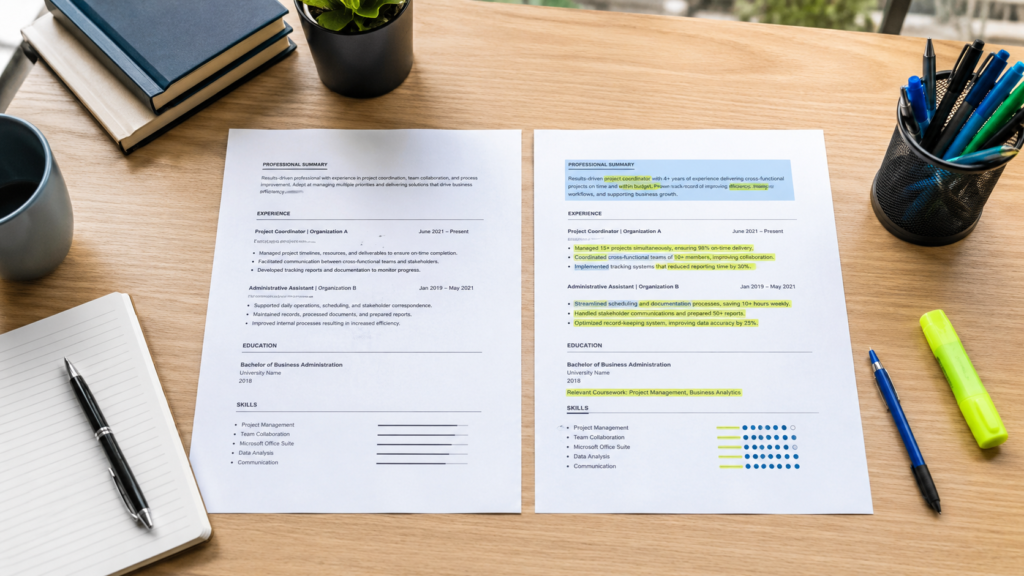
Tailoring your resume for each application consistently outperforms a generic version.
Mistakes Specific to Experienced Professionals
Common mistakes:
- Including too much detail from early-career roles
- Resume exceeding 2 pages with excessive historical detail
- Failing to highlight leadership or specialization gained over time
Required Fix:
- Condense older roles to brief summaries
- Prioritize recent, senior-level achievements
- Highlight leadership, specialization and measurable business impact
Typical Employers Where This Matters: Unilever Pakistan, HBL, Systems Limited, and other structured organizations with defined seniority expectations.
For broader documentation and communication standards, you can also reference resources from the Higher Education Commission of Pakistan.
Fixing Roadmap for Common Resume Mistakes
Review Resume Against This Checklist → Identify Specific Mistakes Present → Rewrite Weak Bullet Points with Achievements → Fix Formatting Inconsistencies → Proofread Thoroughly → Tailor for Target Job → Get a Second Opinion Before Submitting
Frequently Asked Questions
Q1. What is the most common resume mistake in Pakistan?
Sending the same generic, untailored resume to multiple job applications without adjusting it for each specific role is one of the most common mistakes.
Q2. How do I know if my resume has formatting issues?
Check for consistent fonts and spacing, appropriate length (1–2 pages), and ask someone unfamiliar with your background to review it for clarity.
Q3. Are spelling and grammar errors really that costly on a resume?
Yes, they signal a lack of attention to detail and can lead to quick rejection, even for otherwise strong candidates.
Q4. Should I list every job I’ve ever had on my resume?
No, focus on relevant and recent roles; older or irrelevant positions can be condensed or omitted, especially for experienced professionals.
Q5. How long is too long for a resume in Pakistan?
Generally, more than 2 pages is considered too long for most candidates, with 1 page being ideal for fresh graduates.
Q6. What’s wrong with using generic phrases like “hardworking” on a resume?
These phrases are vague and unverifiable; specific, evidenced examples of your work are far more persuasive to recruiters.
Q7. How do I fix a resume that lists duties instead of achievements?
Rewrite each bullet point to focus on the outcome or impact of your work, ideally with a quantified result, rather than just describing the task itself.
Q8. Is it a mistake to use a creative resume design for a corporate job application?
For traditional corporate or government applications, yes — overly creative designs can appear unprofessional and may confuse ATS systems.
Q9. What should I check before submitting my resume?
Review for spelling/grammar, consistent formatting, relevant tailored content, appropriate length, and confirm the file is saved as a PDF.
Q10. How can I fix a resume that feels too generic?
Add specific, quantified achievements, tailor the summary and skills section to each job, and remove vague, unsupported claims.
Q11. Should I ask someone to review my resume before applying?
Yes, a second opinion from a mentor, career office or trusted colleague often catches errors and unclear phrasing you might miss yourself.
Q12. What is a common mistake experienced professionals make on their resumes?
Including too much detail from early-career roles instead of prioritizing recent, senior-level achievements and leadership experience.
Summary
Many resume mistakes in Pakistan’s job market are avoidable with careful review and tailoring — generic content, formatting inconsistencies, language errors and untargeted applications all quietly reduce your chances of getting shortlisted. Knowing these common resume mistakes to avoid significantly improves your resume’s effectiveness.
Key Takeaways
- Tailor your resume for each specific job application rather than sending a generic version.
- Focus on achievements and quantified outcomes, not just job duties.
- Keep formatting clean, consistent and appropriately concise.
- Proofread carefully — errors quietly cost otherwise strong candidates interviews.
- Fresh graduates and experienced professionals face different, specific resume pitfalls.
Suggested Reading
Before applying, also review how to write a CV for jobs in Pakistan, our best resume formats guide, and the ATS-friendly resume guide.
Official Resources
- Higher Education Commission of Pakistan (HEC — Official Website)
Readers should verify specific application requirements directly from individual employer job postings.