
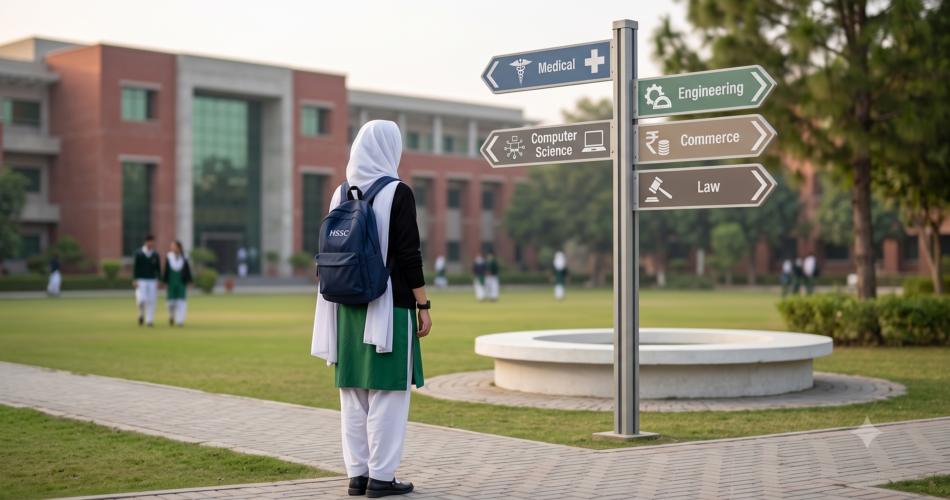
Quick Answer: After Intermediate, Pakistani students typically move into degree programs based on their FSc, ICS, I.Com or FA background — such as MBBS, engineering, computer science, business or law. The right degree depends on entry test performance, financial planning and long-term career goals.
Finishing Intermediate is where your career options after intermediate start to narrow into real, specific professions. This guide covers the realistic degree options available at this stage — who each suits, the skills required, and where each one leads.
Table of Contents
-
- Why This Stage Is Critical
- Options for Pre-Medical Students
- Options for Pre-Engineering Students
- Options for ICS / Computer Science Students
- Options for I.Com (Commerce) Students
- Options for FA (Arts/Humanities) Students
- Comparing the Paths
- Tips and Common Mistakes
- Frequently Asked Questions
Why This Stage Is Critical
Unlike after Matric, your choices after Intermediate are more final. A medical seat, an engineering degree or a CA registration all involve years of commitment. Making an informed decision now avoids costly changes later.
Options for Pre-Medical Students
Best for: Students who completed FSc Pre-Medical and want to pursue healthcare professions.
Required Skills:
- Strong biology and chemistry knowledge
- MDCAT preparation and test-taking ability
- Patience for a long academic and clinical training path
Career Roadmap: FSc Pre-Medical → MDCAT → MBBS/BDS/Pharm-D/DPT/BSN → House Job → Specialization
Typical Employers in Pakistan: Aga Khan University Hospital, Shifa International Hospital, Shaukat Khanum Memorial Hospital, public teaching hospitals.
Official Organizations: Pakistan Medical and Dental Council (PMDC — Official Website)
Consider: Entry depends heavily on MDCAT performance and merit lists, which are highly competitive for government medical colleges. Private colleges are an alternative at higher cost.
Options for Pre-Engineering Students
Best for: Students who completed FSc Pre-Engineering and are strong in mathematics and physics.
Required Skills:
- Strong mathematics and physics foundation
- ECAT preparation
- Technical and analytical problem-solving
Career Roadmap: FSc Pre-Engineering → ECAT → BE/BSc Engineering → Junior Engineer → Senior Engineer/Project Manager
Typical Employers in Pakistan: WAPDA, OGDCL, PPL, Descon Engineering, private construction firms.
Official Organizations: Pakistan Engineering Council (PEC — Official Website)
Consider: Research demand for specific engineering branches before committing, as some specializations have stronger job markets than others.

ICS students often transition into computer science and software degree programs.
Options for ICS / Computer Science Students
Best for: Students who completed ICS or have a strong interest in technology and programming.
Required Skills:
- Programming fundamentals
- Logical and analytical thinking
- Self-directed learning ability
Career Roadmap: ICS → BS Computer Science/Software Engineering/IT/Data Science → Junior Developer → Senior Engineer/Specialist
Typical Employers in Pakistan: Systems Limited, NETSOL Technologies, 10Pearls, Arbisoft, Contour Software.
Official Organizations: Pakistan Software Export Board (PSEB — Official Website)
Consider: This field has strong local and international demand. Practical skills, coding projects and internships often matter as much as your degree title.
Options for I.Com (Commerce) Students
Best for: Students who completed I.Com and are interested in finance, accounting or business.
Required Skills:
- Numerical accuracy and financial literacy
- Analytical thinking
- Attention to detail
Career Roadmap: I.Com → BBA/BS Accounting and Finance/CA/ACCA/CMA → Analyst/Trainee → Manager → Senior Finance Roles
Typical Employers in Pakistan: HBL, UBL, MCB, Meezan Bank, EY Ford Rhodes, KPMG Taseer Hadi.
Official Organizations: Institute of Chartered Accountants of Pakistan (ICAP — Official Website)
Consider: Professional qualifications like CA and ACCA are rigorous and take several years, but lead to some of the highest-paying careers in Pakistan’s finance sector.
Options for FA (Arts/Humanities) Students
Best for: Students who completed FA and are interested in law, media, social sciences or public service.
Required Skills:
- Strong reading, writing and reasoning ability
- Communication and argumentation skills
- Interest in current affairs and society
Career Roadmap: FA → LLB/BA/BS Mass Communication/Public Administration → Entry Role/CSS Preparation → Officer/Associate → Senior Professional
Typical Employers in Pakistan: Law firms, media houses, provincial and federal government departments.
Official Organizations: Federal Public Service Commission (FPSC — Official Website), Pakistan Bar Council (Official Website)
Consider: Arts graduates who plan carefully often do well in law, civil service and media — fields with significant long-term influence and stable demand.
Comparing Career Options After Intermediate
| Background | Common Degree Path | Duration | Entry Test Needed |
|---|---|---|---|
| Pre-Medical | MBBS/BDS/Pharm-D | 4–5 years | Yes (MDCAT) |
| Pre-Engineering | BE/BSc Engineering | 4 years | Yes (ECAT or university test) |
| ICS | BS Computer Science/IT | 4 years | Usually university-specific |
| I.Com | BBA/CA/ACCA | 3–5+ years | Varies by program |
| FA | LLB/BA/BS | 3–5 years | Varies (e.g. LAT for law) |
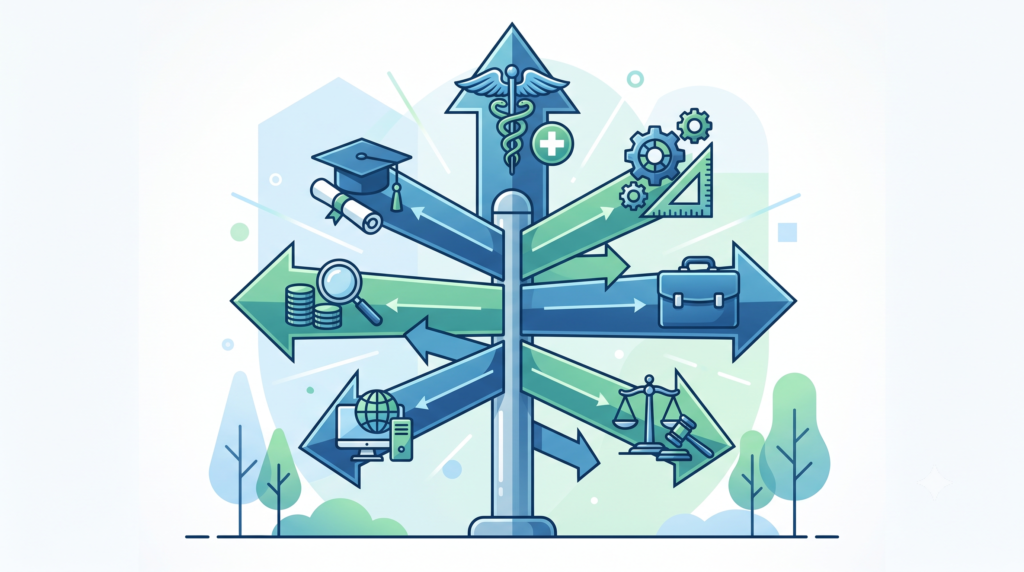
A signpost of icons illustrates the diverse degree paths open to intermediate students.
Tips for Choosing After Intermediate
- When weighing your career options after intermediate, shortlist universities and check their specific admission requirements early.
- Prepare seriously for entry tests relevant to your field.
- Compare government and private university options and costs.
- If unsure, choose a broader degree that keeps multiple career doors open.
- Research scholarship and financial aid options before ruling out expensive programs.
Common Mistakes to Avoid
- Applying to only one or two universities without a backup plan.
- Ignoring entry test preparation until the last moment.
- Choosing a degree based on trends rather than personal aptitude.
- Not researching the actual job market for a specific specialization.
- Underestimating the time and cost of professional qualifications like CA.
Frequently Asked Questions
Q1. What is the best degree after FSc Pre-Medical if I don’t get into MBBS?
There is no single “best” degree among the many career options after intermediate — it depends on your interests, strengths and academic background.
Q2. Can Pre-Engineering students study Computer Science at degree level?
Yes, many universities accept Pre-Engineering students into BS Computer Science or Software Engineering programs.
Q3. Is ACCA better than CA in Pakistan?
Both are respected. CA has strong local recognition, while ACCA has broader international recognition. The right choice depends on your career goals.
Q4. What can FA students study at university level?
FA students commonly pursue law, mass communication, social sciences, public administration and humanities degrees.
Q5. Do I need ECAT for every engineering university?
Not all universities require ECAT specifically; some have their own entry tests. Check your target universities directly.
Q6. Is BS Computer Science better than BS Software Engineering?
Both are strong, closely related fields. Computer Science covers broader theory; Software Engineering focuses more on development processes.
Q7. What is the fastest professional path after I.Com?
A BBA or BS in Accounting and Finance typically offers a quicker route to employment than CA or ACCA.
Q8. Can I change my field completely after Intermediate?
Yes, though some universities require bridge or foundation courses for students switching fields.
Q9. Is CSS preparation something I should start after Intermediate?
CSS requires a bachelor’s degree to apply, but building strong English and current affairs skills early is a helpful head start.
Q10. What if I don’t get admission in a government university?
Private universities are a valid alternative. Compare fee structures, accreditation and job placement records.
Q11. Should I choose a degree based on international demand instead of local demand?
Consider both. Fields like Computer Science, Engineering and Healthcare offer strong opportunities both within Pakistan and internationally.
Q12. How do I know if a university program is properly recognized?
Check that the program is recognized by the relevant regulatory body (HEC, PMDC, PEC) before enrolling.
Summary
The career options after intermediate you choose set the direction for your professional life, but they are not the end of the story.
Key Takeaways
- Entry test performance often matters more than Intermediate marks alone.
- Government and private universities both offer valid paths — compare carefully.
- Broader degrees keep more options open if you’re still unsure.
- Professional qualifications like CA and ACCA require significant time investment.
- Consistent effort matters more long-term than the name of your degree.
Suggested Reading
- Best Career Options After Matric
- Best Career Options After Graduation
- High-Paying Careers in Pakistan
Official Resources
- Pakistan Medical and Dental Council (PMDC — Official Website)
- Pakistan Engineering Council (PEC — Official Website)
- Institute of Chartered Accountants of Pakistan (ICAP — Official Website)
- Higher Education Commission of Pakistan (HEC — Official Website)
Readers should verify current admission criteria, entry test requirements and program recognition directly from official sources.