
Pak Army Long Course Application Guide
Quick Answer: Applying for Pak Army Long Course involves six main steps: confirming eligibility for age and qualification, registering through the official recruitment channel, submitting required documents, sitting the written test, clearing physical and medical screening, and attending the ISSB assessment if shortlisted. Each stage filters candidates before the next, so preparing in this order — rather than jumping straight to test preparation — saves wasted effort on a scheme you may not currently qualify for.
Long Course is the primary route into a permanent commission as a Pakistan Army officer, and it’s also the entry scheme with the narrowest age window and the most competitive applicant pool. Understanding the actual application sequence before you start — not just the eligibility criteria, but the order of steps and what each one requires — makes the difference between a candidate who moves through the process efficiently and one who gets caught off guard by a document or deadline they didn’t know about.
Table of Contents
- Before You Start a Pak Army Long Course Application
- Step 1: Registration Through the Official Channel
- Step 2: Preparing and Submitting Required Documents
- Step 3: The Written Test
- Step 4: Physical and Medical Screening
- Step 5: The ISSB Assessment
- Step 6: Final Selection and Merit
- Common Mistakes During the Application
- Frequently Asked Questions
Before You Start a Pak Army Long Course Application
Direct Answer: Confirm your age and qualification against the current Long Course eligibility criteria before beginning the application, since this scheme has one of the narrowest age windows among Pak Army entry paths.
Long Course eligibility and age limit specifics are covered in dedicated guides linked below — the key point here is sequencing: don’t begin the application process, and definitely don’t begin physical or written test preparation, before confirming you fall within the current bracket for this specific scheme.
Step 1: Registration Through the Official Channel
Direct Answer: Registration for Pak Army Long Course happens through the official recruitment portal or designated recruitment centers, not through third-party job sites or informal channels.
The registration window typically opens ahead of a specific intake cycle, and missing this window generally means waiting for the next cycle rather than being processed late. Registering early within the window, rather than close to the deadline, also gives more buffer time to correct any document or form issues before the cutoff.
Step 2: Preparing and Submitting Required Documents
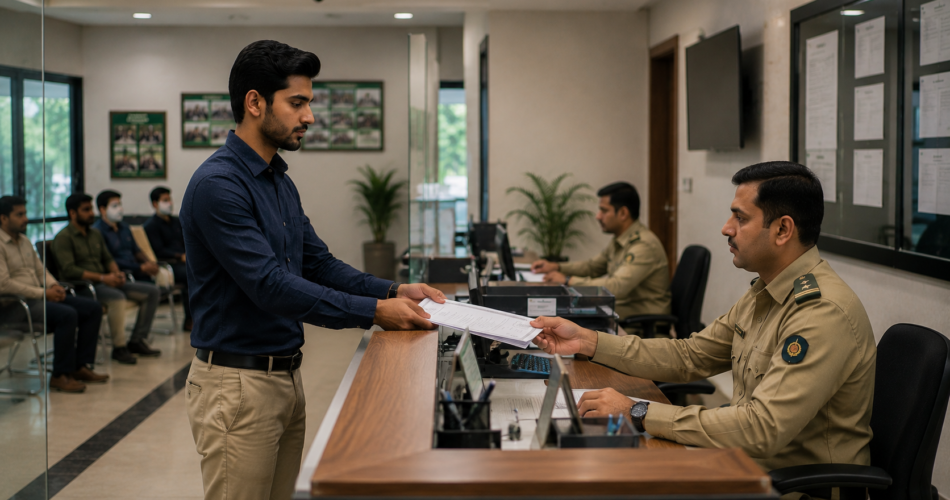
Direct Answer: Required documents typically include academic certificates, a valid national identity document, domicile certificate, and recent photographs meeting the specified format.
Having these ready before registration opens — rather than scrambling to arrange them once the window is live — avoids the most common cause of late or incomplete applications. Academic certificates should match the exact qualification level required for Long Course specifically, since a mismatch here can cause processing delays.
Practical Guidance: Keep both physical and scanned digital copies of every required document ready in advance, since some steps in the process may request either format depending on how the specific intake cycle is administered.

Having every document ready before registration opens avoids the most common delays.
Step 3: The Written Test
Direct Answer: The written test for Long Course covers general knowledge, English, and intelligence/reasoning sections, and candidates who clear it move forward to physical and medical screening.
This test is scheme-specific in its syllabus weighting, so general “government job” test preparation material won’t fully align with what Long Course actually tests. The dedicated Written Test Syllabus guide linked below breaks down the exact sections and how to prepare for each.
Step 4: Physical and Medical Screening
Direct Answer: Physical and medical screening checks height, weight, chest measurement, vision, and general medical fitness against the standards required for Long Course specifically.
This stage happens after the written test in most intake cycles, meaning candidates who haven’t maintained baseline fitness sometimes clear the written test only to be screened out here. Building physical conditioning well before this stage, rather than starting once you’ve been called for screening, is consistently one of the highest-leverage preparation steps.
Step 5: The ISSB Assessment
Direct Answer: Candidates who clear the written test and physical screening proceed to ISSB, a multi-day residential assessment evaluating leadership, psychological suitability, and group behavior.
ISSB is fundamentally different from the earlier stages — it isn’t testing academic knowledge or physical fitness directly, but rather leadership potential and temperament through structured group tasks, individual interviews, and psychological assessment. Treating ISSB preparation as a distinct phase, separate from written test study, consistently produces better outcomes than assuming strong academic performance carries over automatically.

Scheme-specific preparation outperforms generic government-test study material.
Step 6: Final Selection and Merit
Direct Answer: Final selection for Long Course combines performance across the written test, physical standards, and ISSB recommendation into a merit-based outcome, rather than any single stage determining the result alone.
Candidates recommended by ISSB still go through a final medical examination before formal selection, and the overall available seats for a given intake cycle affect how competitive the final merit cutoff is. This is part of why strong performance across every stage — not just clearing the minimum bar at each one — genuinely matters for Long Course specifically.
Common Mistakes During the Long Course Application
Starting physical conditioning only after being called for screening, rather than months in advance, is one of the most frequent and avoidable mistakes specific to this scheme. Submitting documents that don’t precisely match the required qualification level or format is another common cause of delay. Finally, treating ISSB as a formality after clearing the written test, rather than a separate assessment requiring its own preparation, leads many otherwise strong candidates to underperform at that stage.
Frequently Asked Questions
How do I register for Pak Army Long Course?
Registration happens through the official Pak Army recruitment portal or designated recruitment centers during the specific intake window for that cycle — never through third-party job sites, which don’t process official Long Course applications.
What documents do I need for the Pak Army Long Course application?
Typical requirements include academic certificates matching the required qualification level, a valid national identity document, domicile certificate, and recent photographs in the specified format — having both physical and scanned copies ready in advance is recommended.
What happens after I clear the Long Course written test?
Candidates who clear the written test proceed to physical and medical screening, and those who pass that stage move on to the ISSB assessment before final merit-based selection.
Is ISSB the final step in the Pak Army Long Course process?
Not quite — candidates recommended by ISSB still undergo a final medical examination before formal selection is confirmed, and overall merit across all stages determines the final outcome.
Summary
The Pak Army Long Course application moves through six stages — eligibility confirmation, registration, document submission, the written test, physical and medical screening, and ISSB — each of which filters candidates before the next. Preparing for these stages separately and in sequence, rather than treating the whole process as one undifferentiated test, is what consistently distinguishes well-prepared Long Course candidates from those caught off guard partway through.
Key Takeaways
- Registration happens only through the official recruitment channel, never third-party job sites.
- Required documents should match the exact qualification level for Long Course and be prepared in advance.
- Physical conditioning should start months before screening, not after being called for it.
- ISSB evaluates leadership and psychological fitness, requiring separate preparation from written test study.
- Final selection is merit-based across all stages, not determined by any single step alone.
Suggested Reading
Pak Army Complete Guide · Pak Army Eligibility Criteria · Pak Army Age Limit and Relaxation Rules · Pak Army Written Test Syllabus
Official Resources
Register only through the official Pak Army recruitment portal — third-party sites do not process Long Course applications.