
Quick Answer: The three main resume formats are chronological, functional and hybrid (combination). Most job seekers in Pakistan should use one of the best resume formats — chronological or hybrid — since employers generally expect to see a clear work history, while a functional format works best for those with employment gaps or career changes.
Choosing one of the best resume formats can be as important as the content itself — it determines how easily a recruiter can find the information they’re looking for. This guide breaks down the main resume formats, who should use each, and how to choose the right one for your situation.
Table of Contents
- Why Choosing the Best Resume Formats Matters
- Chronological Format
- Functional Format
- Hybrid (Combination) Format
- Comparing the Best Resume Formats
- Which Format Should You Use
- Formatting Best Practices
- Tips and Common Mistakes
- Frequently Asked Questions
Why Choosing the Best Resume Formats Matters
The right format highlights your strengths and minimizes any weaknesses in your work history. A mismatched format — like a functional resume for a candidate with strong, consistent experience — can actually make a resume look weaker than it needs to. Understanding the best resume formats available helps you avoid this mistake entirely.
Chronological Format
Best for: Candidates with a steady, relevant work history and no significant employment gaps.
Structure: Contact Info → Summary → Work Experience (most recent first) → Education → Skills
Consider: This is the most commonly expected format by employers in Pakistan and is generally the safest default choice.
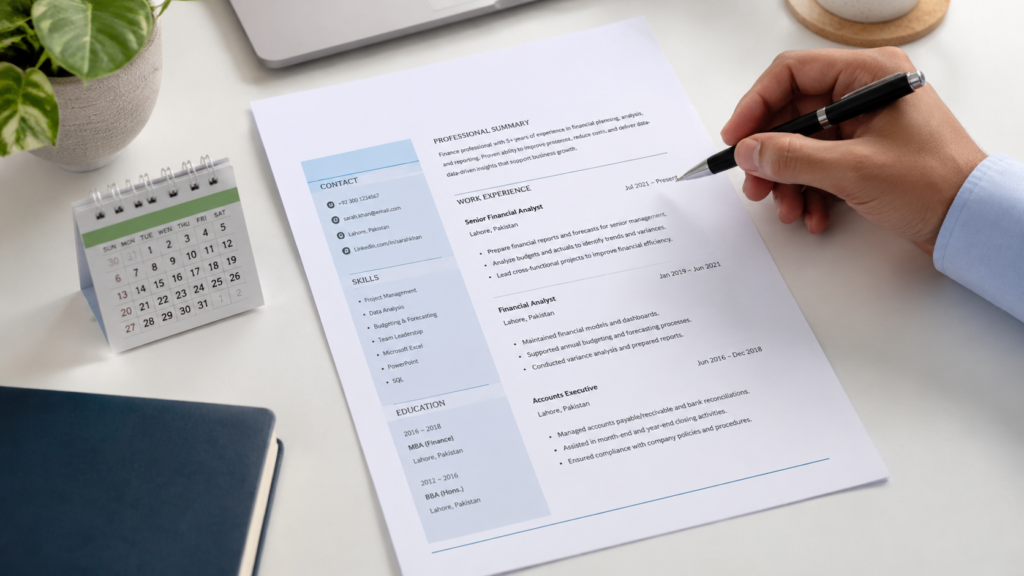
The chronological format is the most commonly expected resume style in Pakistan.
Functional Format
Best for: Candidates with employment gaps, career changers, or those with limited direct work experience who want to emphasize transferable skills instead.
Structure: Contact Info → Summary → Skills Categories (grouped by theme) → Brief Work History → Education
Consider: Some recruiters view this format with slight suspicion, assuming it’s hiding gaps — use it deliberately and be prepared to explain your history honestly in interviews.
Hybrid (Combination) Format
Best for: Most job seekers, especially those with some experience who also want to highlight specific skills prominently.
Structure: Contact Info → Summary → Key Skills Section → Work Experience (most recent first) → Education
Consider: This format balances the clarity of a chronological resume with the skills emphasis of a functional one, making it a strong default for many fresh graduates and professionals.
Comparing the Best Resume Formats
| Format | Best For | Employer Familiarity |
|---|---|---|
| Chronological | Steady work history, no major gaps | Very High |
| Functional | Career changers, employment gaps | Moderate |
| Hybrid | Most job seekers, skills-forward roles | High |
Which Format Should You Use
Career Roadmap for Deciding: Assess Your Work History → Identify Any Gaps or Career Changes → Choose Chronological (steady history), Hybrid (skills-forward), or Functional (gaps/career change) → Apply Consistently Across Applications
Typical Employers in Pakistan and Their Format Expectations: Most private sector companies (Systems Limited, Unilever Pakistan, HBL) and government applications generally expect a standard chronological or hybrid format.
For official application format guidance in academic or government contexts, you can also refer to the Higher Education Commission of Pakistan.

Selecting the right resume format depends on your work history and career stage.
Formatting Best Practices
- Use consistent fonts, sizes and spacing throughout the document.
- Use bold for job titles and company names to aid quick scanning.
- Keep bullet points concise — 1–2 lines each.
- Leave adequate white space; avoid cramming content into a dense block.
- Save and send as a PDF to preserve formatting.
Tips and Common Mistakes
- Don’t use a functional format just to seem creative — use it deliberately for gaps or career changes only.
- Avoid mixing formats inconsistently within the same document.
- Don’t overuse graphics, icons or colors for traditional corporate or government applications.
- Test your resume format by asking someone unfamiliar with your background to scan it for 10 seconds and summarize what they understood.
Frequently Asked Questions
Q1. What is the most commonly used resume format in Pakistan?
The chronological format, or a hybrid version of it, is the most commonly used and expected format across most industries in Pakistan.
Q2. Should fresh graduates use a functional resume format?
Not usually. A hybrid format that highlights skills alongside a brief work/internship history generally works better for fresh graduates than a purely functional format.
Q3. Is a functional resume format suspicious to employers?
Some recruiters may view it with slight caution, assuming it’s used to hide gaps, so use it deliberately and be prepared to address your history honestly in an interview.
Q4. Can I use a creative resume format for a marketing or design role?
For creative fields, a visually distinct resume can work well, but ensure it remains easy to read and includes all standard information clearly.
Q5. What format is best for government job applications in Pakistan?
Follow any specific format required by the official application, but generally a clear chronological format works best for government applications.
Q6. How do I handle a career change using a resume format?
A hybrid or functional format that emphasizes transferable skills at the top, before diving into work history, works well for career changers.
Q7. Does resume format affect how Applicant Tracking Systems (ATS) read my resume?
Yes, some highly designed or unconventional formats can confuse ATS software. Simpler, standard formats are generally more ATS-friendly.
Q8. Should I use a resume template found online?
Yes, as long as it’s clean, professional and easy to customize — just ensure it doesn’t use overly complex formatting that could confuse ATS systems or look cluttered.
Q9. How do I choose between one-column and two-column resume layouts?
Single-column layouts tend to be safer for ATS compatibility and traditional employer expectations; two-column layouts can look modern but carry some ATS parsing risk.
Q10. Is it okay to use a resume format with a photo?
This depends on company norms in Pakistan — some traditional companies expect a photo, while multinational corporations often do not require one. Check the specific job posting when possible.
Q11. How long should each section be in a chronological resume?
Keep the summary to 2–3 lines, and work experience bullets to 1–2 lines each, focusing on the most relevant and recent experience.
Q12. Can I switch resume formats between different job applications?
Yes, it’s reasonable to adjust format slightly based on the role and industry, as long as each version remains clear and professional.
Summary
Choosing among the best resume formats — chronological, functional, or hybrid — depends on your specific work history and career situation. For most job seekers in Pakistan, a chronological or hybrid format works best, while a functional format should be reserved for specific situations like career changes or employment gaps.
Key Takeaways
- Chronological format is the safest default for most job seekers in Pakistan.
- Hybrid format balances skills emphasis with a clear work history.
- Functional format should be used deliberately for gaps or career changes.
- Consistent, clean formatting improves recruiter readability significantly.
- Save your resume as a PDF to preserve formatting across systems.
Suggested Reading
Official Resources
Readers should verify any specific format requirements directly from individual employer job postings.